
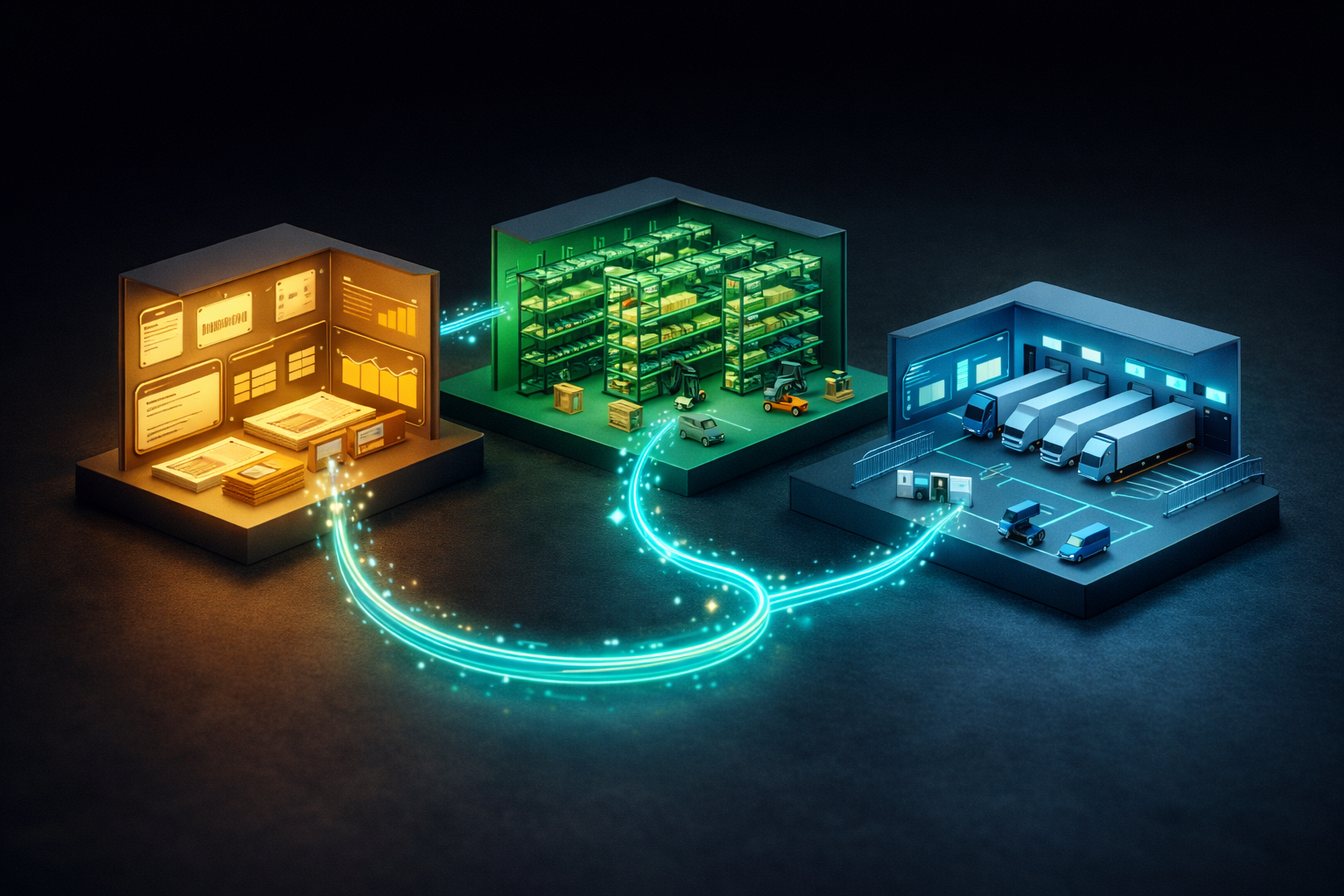
If you are evaluating logistics software and still asking whether you need a YMS, a WMS, or a TMS, you are asking the right question. Most operations teams do not fail because they bought no technology. They fail because they bought the wrong system first, or expected one system to solve a problem owned by another.
In practical terms, each platform manages a different operational layer:
When those boundaries are unclear, teams create manual bridges with calls, chats, and spreadsheets. That is where delays, penalties, and avoidable costs begin.
This guide breaks down the real boundaries between a yard management system, a warehouse management system, and a transportation management system — with a decision framework to help you choose the right rollout order for your operation.
A fast way to frame the difference:
The simplest distinction is this: YMS runs the handoff zone, WMS runs inside the warehouse, and TMS runs movement across the network. When an operations team confuses these boundaries, the result is not just wasted spend — it is an organizational gap where no system has clear ownership, and people fill it with workarounds.
Two trends make this decision more urgent than it was a few years ago.
First, teams are investing heavily but still missing value. The 2025 MHI annual report coverage (produced with Deloitte) says 55% of supply chain leaders increased technology budgets, with 60% of those spending more than $1M and 19% planning more than $10M (MHI Solutions). Investment is rising, but operational outcomes do not rise automatically. A large budget allocated to the wrong system is still a bad allocation.
Second, execution gaps are expensive. Gartner predicts that by 2028, 60% of supply chain digital adoption efforts will fail to deliver promised value when organizations underinvest in talent and process change (Gartner press release, May 7, 2025). That failure rate is not about the software itself — it is about buying the wrong tool for the wrong stage, or expecting technology to fix a process problem.
On the cost side, McKinsey estimates that inefficient handoffs in mid- and last-mile operations can represent 13% to 19% of logistics costs, equivalent to up to $95 billion in annual waste in the US (McKinsey). Handoffs between gate, yard, dock, and warehouse are precisely where YMS coverage begins and WMS coverage ends — and where most visibility is lost.
And detention is still a major issue. ATRI reported drivers were detained in 39.3% of stops in 2023, with multi-billion-dollar direct and productivity impact across the industry (ATRI release).
The conclusion is straightforward: if your system boundaries are wrong, software spend becomes operational friction.
Use this process map to remove ambiguity in your operation. Each stage below has a primary owner and, in some cases, a secondary system that provides data or triggers the next step.
If one platform tries to absorb all six layers, users usually return to manual workarounds within weeks.
| Dimension | YMS | WMS | TMS |
|---|---|---|---|
| Core objective | Orchestrate gate-yard-dock flow | Control inventory and warehouse tasks | Optimize transportation execution and costs |
| Operational scope | Facility perimeter and yard | Inside warehouse walls | Between origins, hubs, and destinations |
| Primary users | Gate team, yard control, dock coordinators | Warehouse supervisors, inventory teams, pick-pack teams | Transport planners, carrier management, logistics finance |
| Key decisions | Appointment slot, queue order, dock assignment | Put-away, replenishment, picking, cycle count | Carrier selection, route, mode, tender, consolidation |
| Time horizon | Minutes/hours | Hours/days | Days/weeks |
| Typical KPI focus | Check-in time, yard dwell time, dock occupancy, detention | Inventory accuracy, pick rate, dock-to-stock, order cycle | Freight cost per shipment, on-time delivery, tender acceptance |
| Most common blind spot if missing | Yard congestion and poor dock orchestration | Poor stock visibility and warehouse inefficiency | High freight spend and poor network control |
A useful rule: if the truck is outside the building, YMS/TMS are in play; if product is being transacted inside the building, WMS is in play. Understanding this boundary is the key to avoiding overlap when you evaluate dock management for your distribution center.
Not every operation should deploy all three systems at once. Start with the current bottleneck.
You likely need YMS first if you see:
For this scenario, begin with appointment control, digital check-in, queue visibility, and dock orchestration. The goal is to bring structure to the handoff zone before optimizing what happens inside the warehouse or across the network. If you need practical context: What is a YMS and Digital check-in at the security gate.
You likely need WMS first if you see:
In this case, a yard layer can wait if truck volume is still predictable and low. But once arrivals become volatile — seasonal peaks, nearshoring growth, multi-supplier windows — YMS usually becomes the next priority to protect WMS throughput. A warehouse that runs well internally still suffers when trucks arrive at the wrong time or dock assignments are chaotic.
You likely need TMS first if you see:
In this case, TMS creates transport control across the network. But if receiving windows are unstable at your sites, TMS alone will not fix arrival execution — the problem will surface as poor carrier compliance when it is actually a facility scheduling issue.
If you are unsure where to begin, run a 2-week diagnostic on three numbers: average gate check-in time, dock waiting time, and freight cost per shipment. The largest sustained variance usually points to your first system.
If you want a practical benchmark for yard-related bottlenecks, start with these yard KPIs.
Not sure which system to prioritize? Start a free Docklyx trial and measure your gate-to-dock baseline in one week — that data will tell you where to invest first.
The strongest architecture is not "one system does all." It is a clear event chain with minimal duplication.
A practical integration flow looks like this:
For most mid-size operations, this can start with simple API exchange and a shared reference model:
Without shared IDs, integrations degrade into brittle spreadsheet reconciliation. The first integration to build is almost always the check-in event from YMS that triggers receiving preparation in WMS — it delivers the most immediate throughput improvement.
Teams compare vendor decks before mapping bottlenecks. The result is expensive over-functionality in one area and critical gaps in another. A 200-feature WMS does not help if the real problem is 90-minute gate queues.
A WMS may register receiving events, but it usually is not optimized for gate queues, trailer parking logic, or real-time dock sequencing. Attempting to stretch WMS into the yard creates a system that does neither job well.
TMS can optimize route plans and carrier selection across the network. It cannot, by itself, orchestrate gate throughput or dynamic dock reassignment at minute-level granularity. The data handoff between TMS and facility execution is where most implementations leave a gap.
Gartner's warning on digital adoption failure is a process and people warning, not only a technology warning. If gate guards, warehouse supervisors, and transport coordinators keep old workflows, new tools become another layer of manual work — not a replacement for it.
Many projects launch each platform in isolation and postpone integration to "phase two." That creates duplicate master data, conflicting event timelines, and weak traceability. Plan the first integration handoff from day one, even if the implementation starts with only one system.
A regional distributor in Guadalajara operating 18 docks and processing around 45 units per day had an issue that looked like a "transport problem" but was actually a yard orchestration problem.
Before implementation: The operation relied on phone calls between the gate guard and the warehouse coordinator to assign docks. There was no structured appointment schedule. Carriers arrived whenever they wanted, and the guard logged arrivals in a paper notebook. Average gate check-in took over 12 minutes. Dock assignments changed multiple times per shift based on whoever was loudest on the radio. The result: high detention penalties, unpredictable receiving schedules, and warehouse teams that could not prepare for incoming loads.
What changed: In phase one, the team implemented YMS controls: scheduled appointments with time slots, QR-based digital check-in, and structured dock assignment rules based on cargo type and priority. Gate check-in dropped to under 2 minutes. Dock reassignments decreased because the system assigned based on actual availability, not radio negotiation.
Result: In 90 days, the operation reduced demurrage costs by 73%, as documented in this case study. Warehouse receiving predictability improved because the team could see the yard queue 30 minutes before trailers reached the dock.
The relevant lesson is not that every site should buy YMS first. The lesson is that the first system should match the first bottleneck. For this operation, yard control unlocked value faster than a broader platform change would have.
Use this checklist to reduce implementation risk regardless of which system you deploy first.
Do not scale before pilot data proves real process adoption. A pilot that works on paper but relies on workarounds in practice will fail at full volume.
In most medium- and high-volume operations, no. A WMS tracks what happens at the dock and inside the warehouse — receiving confirmations, put-away tasks, inventory movements. It is not designed to manage gate queues, yard trailer positions, or real-time dock sequencing based on arrival priority. Operations that try to stretch their WMS into yard control usually end up with a parallel spreadsheet tracking what the WMS cannot see.
No. TMS optimizes transport planning and carrier execution across the network — routes, rates, tenders, delivery milestones. Once a truck reaches your facility gate, TMS has no mechanism to manage check-in speed, yard positioning, or dock assignment. The two systems are complementary: TMS controls the road, YMS controls the site.
Not always. Many operations start with one system based on the main operational constraint and add the others as volume and complexity increase. A 5-dock facility with 10 daily arrivals may manage well with just a YMS. A large DC with high SKU count and complex picking may need WMS first. The key is matching the system to the bottleneck, not to a theoretical maturity model.
ERP can centralize data and financial control, and some ERPs include basic WMS or TMS functionality. However, for high-velocity logistics execution — gate throughput, real-time dock orchestration, dynamic routing — dedicated platforms typically outperform ERP modules because they are built for operational speed rather than transactional record-keeping.
Three things: operational fit to your specific bottleneck, adoption by the people who will use the system daily (gate guards, dock coordinators, warehouse operators), and clean event integration so data flows between systems without manual reconciliation.
Treat YMS, WMS, and TMS as complementary layers, not competing alternatives.
Then integrate all three around shared events and shared KPIs. The sequence matters more than the brand. The bottleneck decides the order.
If you operate a DC and want to benchmark your first step, start with Docklyx's free trial and map your gate, yard, and dock baseline in the first week.
Docklyx digitizes the entire yard: appointments, check-in, docks, and real-time traceability.
Request free demo →One email per week. No spam.
How AI carrier scoring works: punctuality, no-shows, dwell time, and dock priority. Practical guide for warehouse operators.
Discover what a YMS is, how it works, and why it's essential for optimizing your distribution center or warehouse yard in Mexico.