
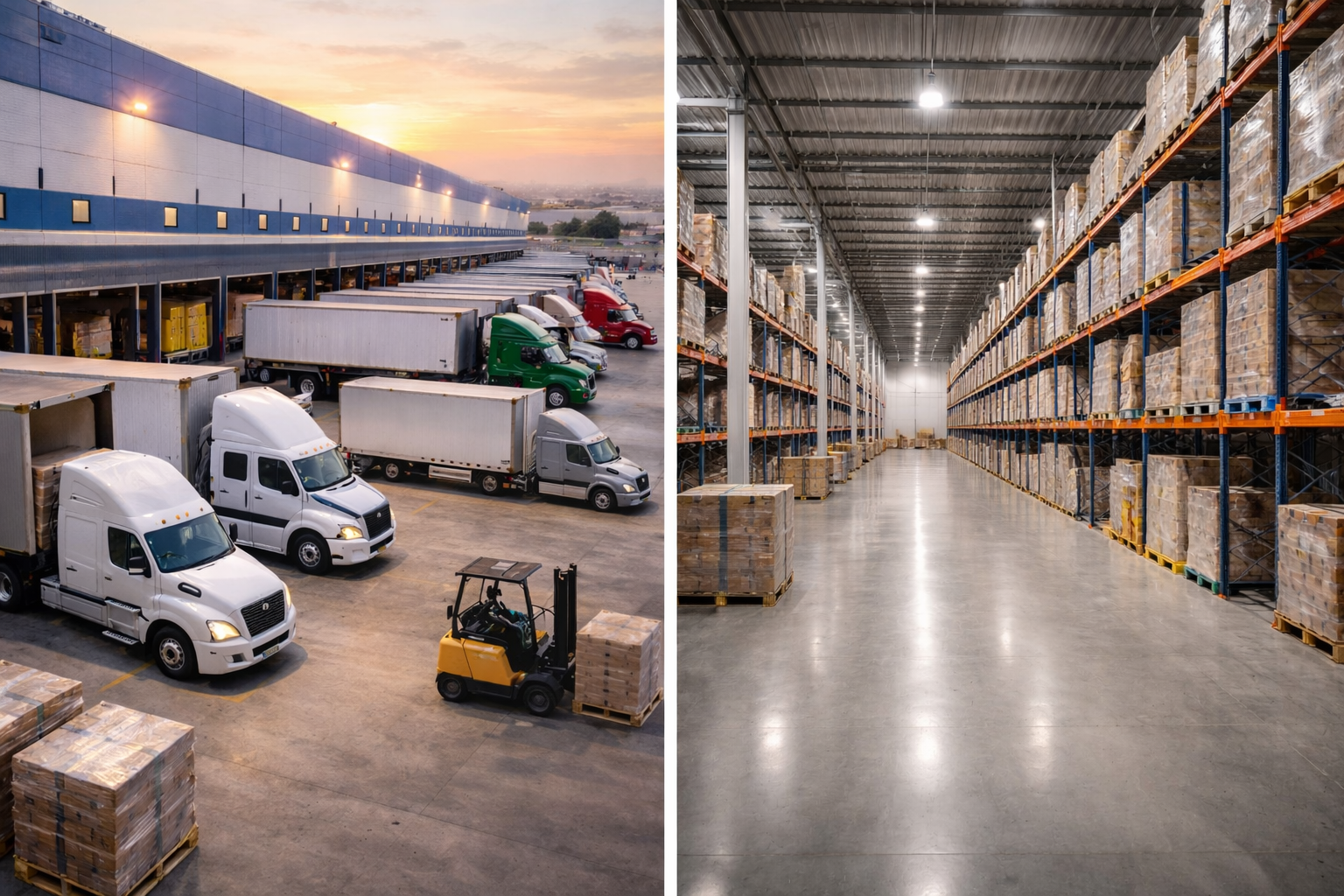
In the logistics environment of 2026, terminology precision is more than semantics—it's a strategic decision that directly impacts profitability and technology stack choices. Often, the terms "DC" (Distribution Center) and "warehouse" are used interchangeably, but their operational realities, financial goals, and software requirements are diametrically opposed.
According to a recent Gartner (2025) report, 65% of companies that fail in their logistics digitalization projects do so because they attempt to implement software designed for static storage (warehouse) in a high-flow operation (DC), or vice versa. Understanding these differences is the first step toward optimizing your supply chain and eliminating inefficiencies that can cost millions of dollars annually.
This comprehensive guide analyzes the critical differences between both models and details which digital tools each needs to thrive in today's market.
A Distribution Center (DC) is the beating heart of modern logistics. Its fundamental purpose is not to store goods, but to accelerate flow. In the context of nearshoring and same-day delivery e-commerce, a DC functions as a high-speed transit node.
Operational characteristics of a DC include:
Typical examples: distribution centers for giants like Walmart, Amazon, or major retail chains, where the goal is for the product to reach the point of sale or the end customer as quickly as possible.
Conversely, a warehouse is designed for custody and preservation. Its primary function is static storage for extended periods, serving as an inventory buffer for manufacturing or a strategic reserve.
Operational characteristics of a warehouse include:
Typical examples: raw material warehouses in automotive plants, industrial spare parts stores, or document archive storage centers.
| Characteristic | Distribution Center (DC) | Warehouse |
|---|---|---|
| Main Goal | Maximize flow and transit | Maximize custody and density |
| Avg. Residence Time | < 72 hours | > 30 days |
| Loading Docks | 40 - 150+ | 2 - 15 |
| Carrier Relations | Dynamic and high-friction | Stable and low-friction |
| main processes | Cross-docking, massive picking | Receiving, put-away, cycle counts |
| Demurrage Impact | Critical (massive losses) | Moderate (manually manageable) |
| Dominant Tech | YMS (Yard Management) + WMS | WMS + ERP |
To better understand how velocity impacts costs, we recommend reading about what demurrage is in Mexico.
One of the most common mistakes in logistics is believing that a WMS (Warehouse Management System) is enough to manage a DC. While the WMS controls what happens inside the walls, it is blind to what happens in the yard and at the security gate.
A modern DC needs a software triad to be efficient:
For a warehouse, the focus should be on precision:
Data from international consultants show a growing gap between digitized and manual operations:
If you want to know how to measure these impacts, check out our guide on logistics yard KPIs.
Company: 3PL Logistics Operator in North America.
Initial Situation: The company traditionally operated as a storage warehouse for the automotive industry. Due to market shifts, a retail client hired them to manage regional distribution. They tried to operate this new high-flow (DC) model with their traditional warehouse software.
The Problem: In less than 30 days, the truck queue at the entrance blocked the main access road. Demurrage costs skyrocketed to $30,000 USD weekly. The security gate guard resigned due to the stress of managing 80 trucks daily with a notebook and a radio.
The Solution: They implemented Docklyx in one week. They moved from a "show up when you can" model to a mandatory appointment portal and QR-based digital check-in.
Results:
Regardless of whether your operation is more like a warehouse or a DC, Docklyx provides a layer of visibility that traditional systems ignore. Here is how the workflow looks:
Docklyx replaces paper logs with a tablet and QR scanning. If you are a DC, the system validates the appointment; if you are a warehouse, it registers asset entry and unit status digitally and instantly.
Our "Control Tower" view allows you to see which docks are occupied and by whom. For a DC, this is important for cross-docking; for a warehouse, it's ideal for security audits and asset control.
No more shouting or drivers climbing out of their cabs to ask if it's their turn. Docklyx sends automated WhatsApp notifications: "Unit 205, please proceed to Dock 4". This maintains fluidity and safety in the yard.
In practice, you generate precise reports. There are no arguments about when a truck arrived. Docklyx data is the "single source of truth" for settling transportation invoices and avoiding unjustified demurrage charges.
In 2026, the distinction between a DC and a warehouse is more than theoretical; it's financial. If your operation requires speed, don't try to manage it with tools designed for static storage. Investing in a system that understands yard dynamism is the difference between being a logistics leader or a supply chain bottleneck.
Is your DC operating blind, or do you have total control of your docks?
Optimize your operation today. Schedule a Docklyx demo here.
Docklyx digitizes the entire yard: appointments, check-in, docks, and real-time traceability.
Request free demo →One email per week. No spam.